
Body & Embodiment
As I watch my body change through every phase of its wise femininity, I find myself lost in thoughts about what this “body” truly means to me. I’m used to seeing myself in motion, to feeling myself in the dance of my hands, the sway of my hips, and the geometry of my steps; but before all of this—or perhaps I should say, while all of this exists—there is a structure made of bones, muscles, cartilage, skin, and lymph flowing through my veins—an objective entity that simply “is.”
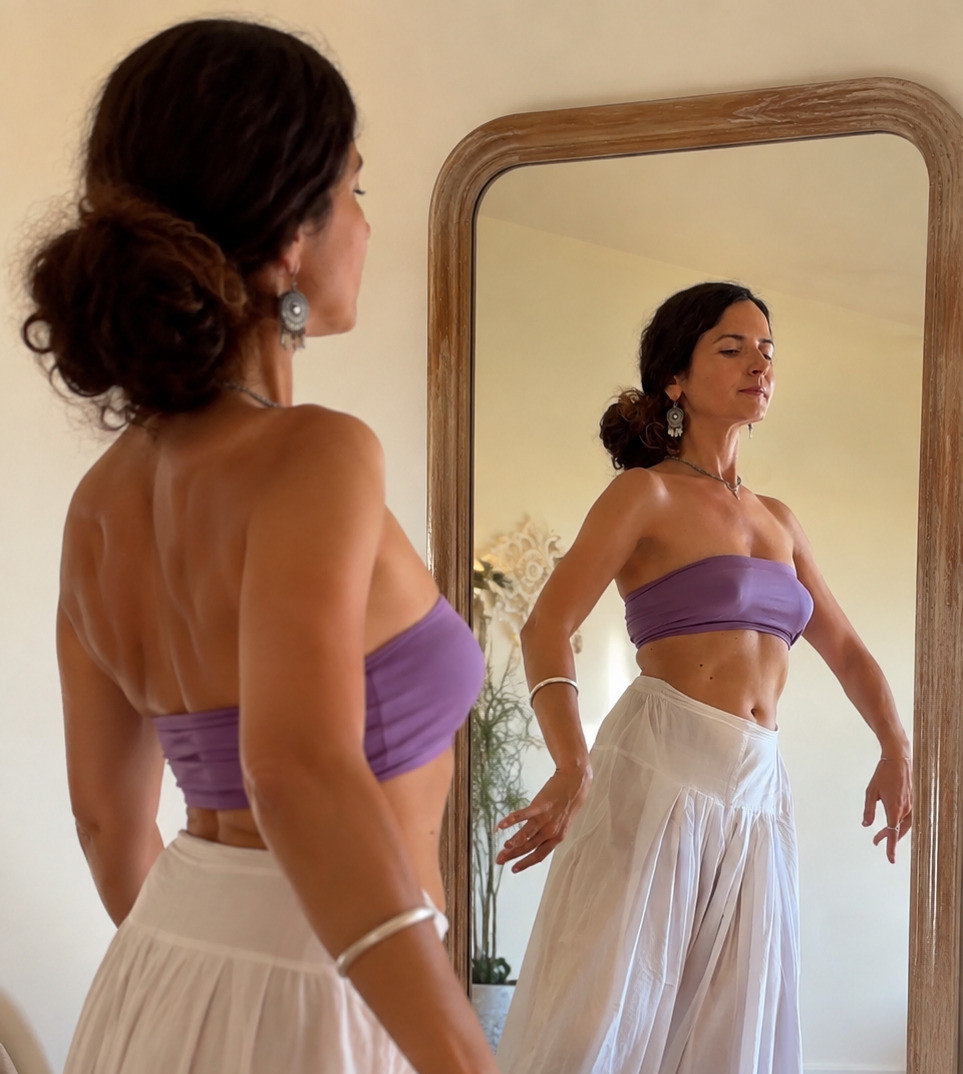
Yet when I look at myself in that mirror, I see that there is more; there is a subjective self beyond the shape of my visible outline that expresses itself through movements, facial expressions, and glances—all of which reflect my thoughts and emotions in that instant. In this interplay between seeing and feeling, I am already engaging in a partial “embodiment.”
I love this English term because it contains the words “body,” “mens” (mind), and “em” (within), indicating a holistic experiential journey where, through the body and mind, one merges with the surrounding context and then reemerges each time with a greater awareness of one’s own presence. And on this subject, I’d like to quote here an excerpt from my recent thesis titled “Trance and Transcendence:Devotional and Healing Dances from a Shamanic Perspective,” in which I explore this topic.
“In Vedānta philosophy—one of India’s major philosophical and spiritual traditions, which originated in the 8th century B.C. and fully developed by the 13th century A.D.—the concept of embodiment is addressed in relation to the definitions of the “individual” and the “whole,” Brahman. The moment consciousness takes form in a body-mind, it is seen as a separate ‘individual’ that, through the process of embodiment, emerges from the whole.
Thus, incarnation or identification is an illusion and not a real birth; it is a mistaken view of a fragmented Brahman.
“Tat tvam asi”: You are That (Chāndogya Upaniṣad 6.8.7, ca. 800–600 BCE)
“That” here refers to the whole, the tat, the absolute principle; tvam is the individual, the embodied self; asi means “you are.”
And so, returning to the present day, the process of embodiment is precisely that journey toward the awareness that we are part of a whole, that the context surrounding us is ourselves, and that being an individual cannot be separated from this.
[…] this quest for “non-separation” is the common thread running through certain forms of prayer, dance, or healing rituals in which the body merges with universal consciousness—the divine or ecstatic experience—to detach from its own physical presence and the flaws of the ego, and to free itself, even if only for a moment, in the full awareness of the whole.”
And so, movement as liberation—a longing to break free from it all, or simply the need to release emotions that have been latent within us for far too long. We tend to live in our bodies as if we were trapped in cages: judgments, cultural legacies, religious impositions, beauty stereotypes, trends… to name just a few of the factors that dictate how the bodies we inhabit must be.
Returning to myself in front of the mirror, today I am able to see beyond the surface and observe, in every shape, line on my skin, and expression wrinkles, the sum of the experiences I have consciously lived through so far on my ongoing journey of embodiment.
What do you see when you look yourself in the mirror?
In my next post, I’ll talk about the body and myth.


Comments